C++ Memes

C++: where you can shoot yourself in the foot, then reload and do it again with operator overloading. These memes celebrate the language that gives you enough power to build operating systems and enough complexity to ensure job security for decades. If you've ever battled template metaprogramming, spent hours debugging memory leaks, or explained to management why rewriting that legacy C++ codebase would take years not months, you'll find your digital support group here. From the special horror of linking errors to the indescribable satisfaction of perfectly optimized code, this collection honors the language that somehow manages to be both low-level and impossibly abstract at the same time.
Data Types

Data Types
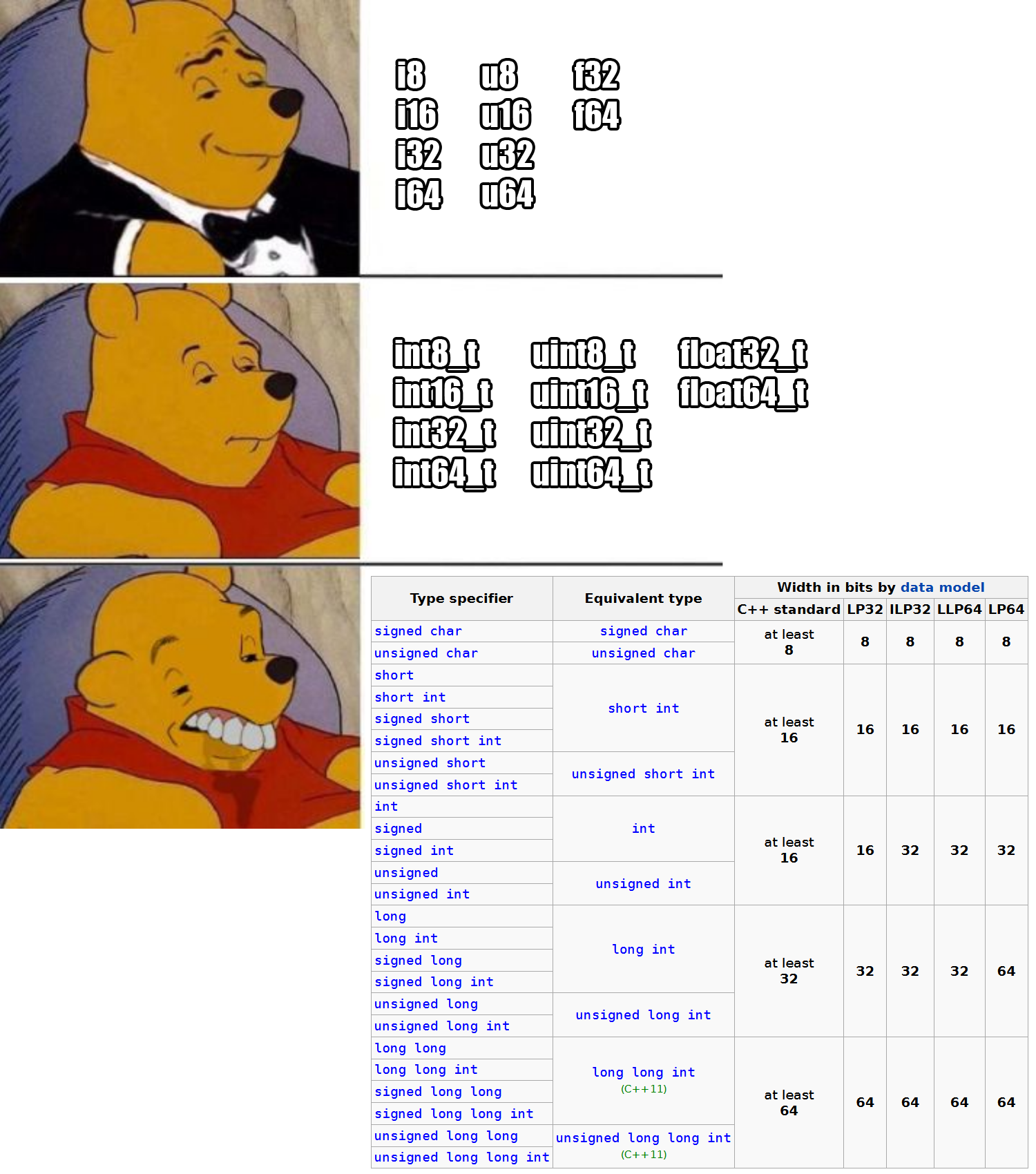
The evolution of a developer: from blissfully using i8 and u32 like a normal human being, to awkwardly typing int8_t and uint16_t because you read best practices once, to finally achieving enlightenment by pulling up a 47-column compatibility table just to figure out if your int is 16 or 32 bits on this particular Tuesday. C and C++ really said "let's make integer sizes platform-dependent" and then watched the world burn. Nothing says "portable code" quite like needing a PhD to understand whether long is 32 or 64 bits depending on whether you're compiling for Windows, Linux, or a toaster running embedded firmware. Meanwhile, Rust devs are smugly sipping their coffee with their explicit i32 and u64 types, wondering what all the fuss is about.

Can Someone Please Make Programming Good Again

Can Someone Please Make Programming Good Again
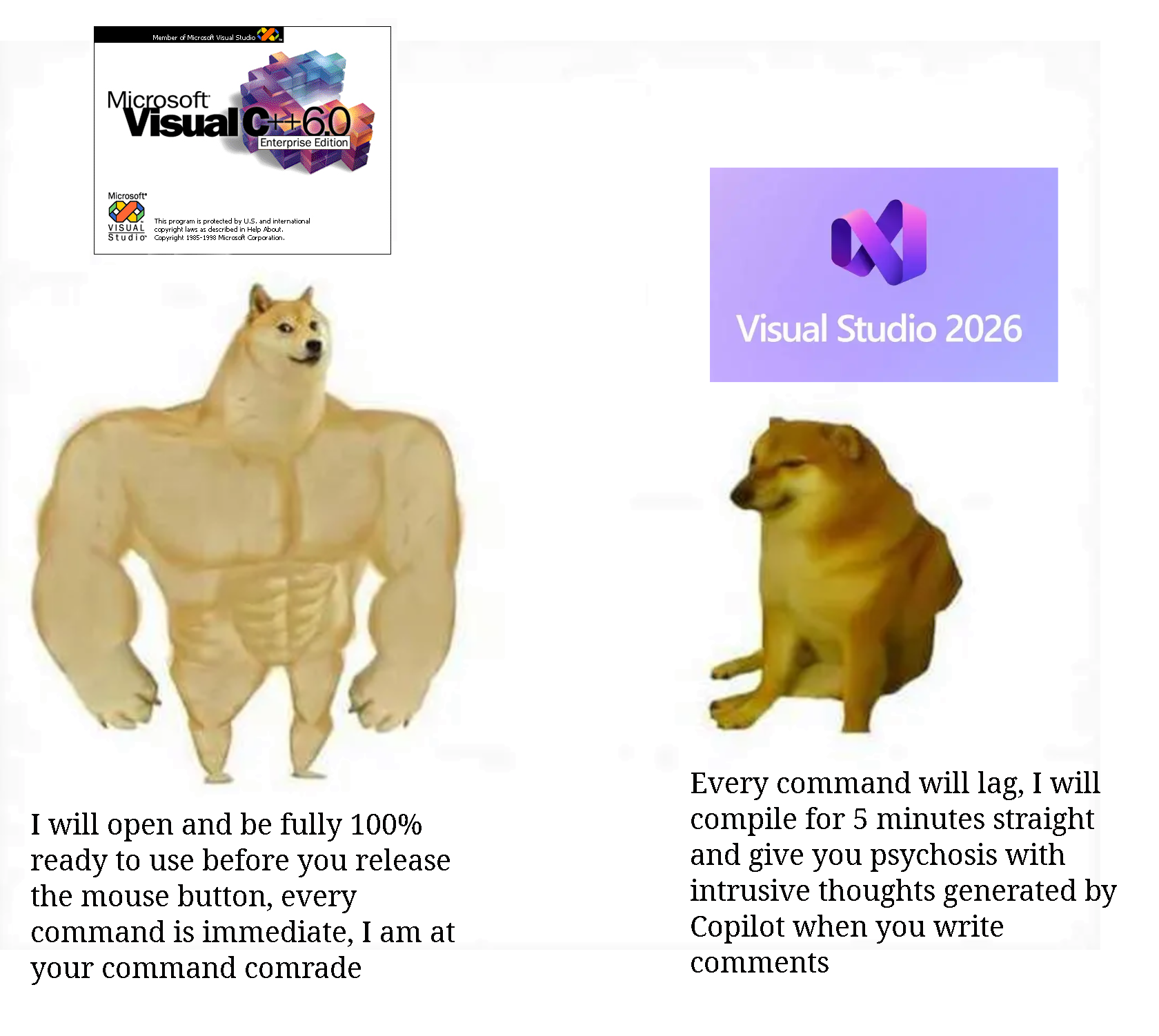
Visual Studio C++ 6.0 from 1998 was basically a tank - instant startup, zero lag, ready to compile before you even sat down. Fast forward to 2026 and we've got bloatware that takes longer to boot than Windows Vista, compiles at the speed of continental drift, and Copilot aggressively suggesting code in your comments like an overeager intern who won't shut up. The nostalgia hits different when you remember IDEs that didn't need 16GB of RAM just to say "Hello World." Sure, VS6 had the UI of a tax software from the '90s, but at least it didn't try to psychoanalyze your TODO comments with AI. Progress™ means trading snappy performance for features nobody asked for. Thanks, I hate it.

Aging As A Programmer Sucks

Aging As A Programmer Sucks
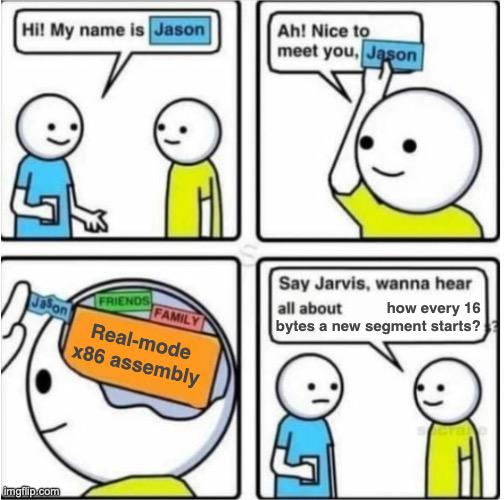
The brain's priority system evolves in fascinating ways. When you're fresh in the industry, you can remember every person's name at a networking event. Fast forward a few years of debugging segfaults and dealing with legacy code, and suddenly your brain has reallocated that precious memory space to store the exact locations of "FRIEND" and "FAMILY" labels in your mental heap, right next to the sacred knowledge of x86 assembly instructions. The joke here is that while you can't remember Jason's name anymore, you can instantly recall obscure technical details like how every 16 bytes is a new segment in x86 assembly. Your brain basically performed garbage collection on "useless" social information to make room for the really important stuff —like real-mode memory addressing and assembly opcodes. Who needs to remember people when you can remember that the x86 architecture uses segmented memory addressing where a physical address equals segment × 16 + offset? Peak programmer evolution: social skills deprecated, low-level knowledge optimized. 10/10 would forget your name again.

Blazingly Slow FFmpeg

Blazingly Slow FFmpeg
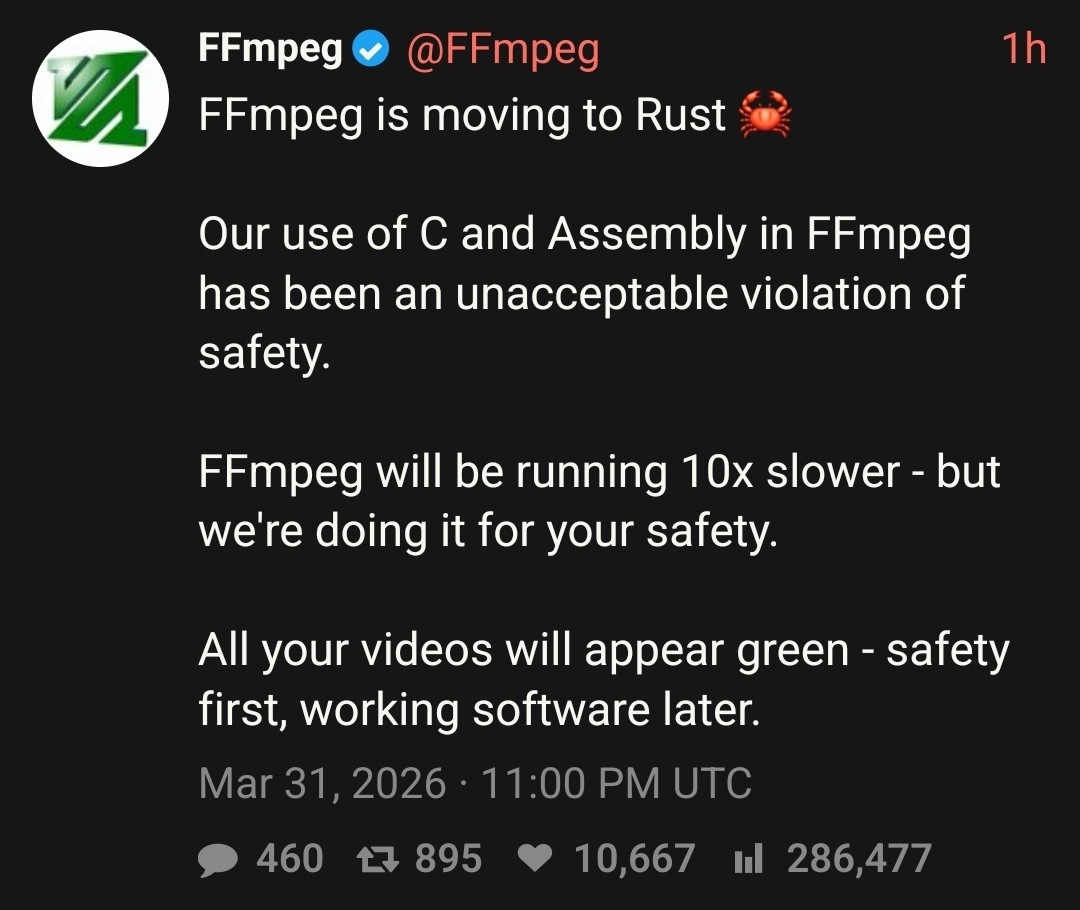
This is a beautiful parody of the Rust evangelism that's taken over the tech world. FFmpeg, one of the most battle-tested and optimized pieces of software ever written in C, announces it's rewriting in Rust because C is an "unacceptable violation of safety." The punchline? It'll run 10x slower, but hey, at least it's safe! And all your videos will be green because, you know, safety first, functionality later. The irony here is chef's kiss. FFmpeg has been processing billions of videos for decades without issue, but apparently that's not good enough for the Rust crusaders. The "blazingly fast" tagline that Rust fans love to throw around gets flipped on its head – now it's "blazingly slow." Because nothing says progress like making software 10x worse in the name of memory safety that wasn't actually a problem.

Easy

Easy
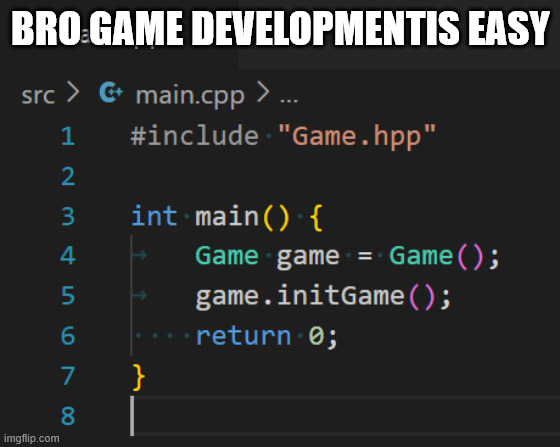
Oh sure, just instantiate a Game object, call initGame(), and boom—you've got the next AAA title ready to ship. Seven lines of C++ and you're basically competing with Unreal Engine 5. The real kicker is that "Game.hpp" header file doing all the heavy lifting while you pretend your main.cpp is the genius behind it all. That single header probably contains 50,000 lines of physics engines, rendering pipelines, AI pathfinding, and enough spaghetti code to make an Italian chef weep. But hey, game development is easy when you abstract away literally everything that makes it hard. This is the programming equivalent of those "how to draw an owl" memes where step 1 is drawing two circles and step 2 is "draw the rest of the owl." Just hide all the complexity in a header file and call it a day.

Day Counter: It Has Been −2,147,483,648 Days Since Our Last Integer Overflow

Day Counter: It Has Been −2,147,483,648 Days Since Our Last Integer Overflow
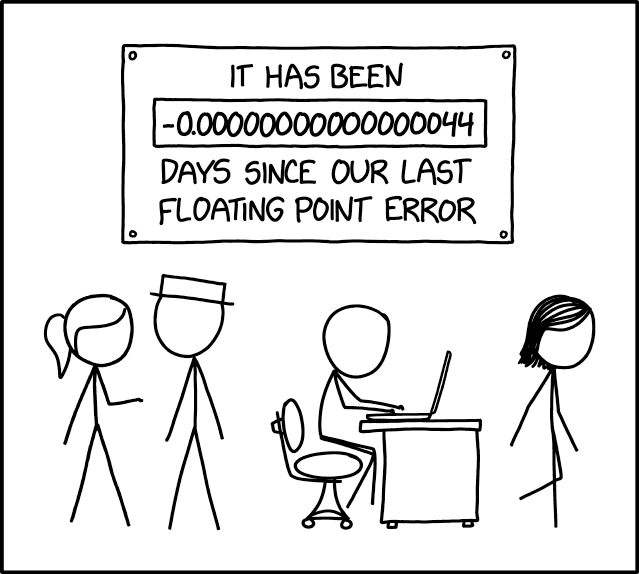
When your safety sign literally becomes the safety hazard. That floating point number is so cursed it probably has more decimal places than your last sprint had story points. The counter meant to track "days since last floating point error" is itself experiencing a floating point error—it's like having a fire extinguisher that's on fire. The title references the infamous 32-bit signed integer overflow at 2,147,483,647 (which wraps to -2,147,483,648), but the sign shows a floating point disaster instead. Two different numeric nightmares for the price of one. The irony is chef's kiss—you can't even trust your error tracking system to not have errors. It's bugs all the way down. Everyone in the office just casually accepting this is peak developer culture. "Yeah, the safety counter is broken again. Just another Tuesday." Nobody's even looking at it anymore. They've seen things. They know better than to question the machines at this point.

Blazingly Fast

Blazingly Fast
The Rust evangelists have been working overtime, and now even C++ developers are starting to crack. That peaceful sleeping face? That's the look of someone who finally ditched their segfaults and use-after-free bugs for a language that yells at them during compile time instead of production. "Blazingly fast" has become the Rust community's favorite phrase, right up there with "fearless concurrency" and "zero-cost abstractions." The joke here is the double meaning of "rust" - your car rusting is usually bad news, but Longsocks here is sleeping like a baby because their car rusting means they've finally switched to the Rust programming language. Memory safety AND speed? Sweet dreams indeed. Fun fact: The Rust compiler's error messages are so helpful they've been known to teach better than some university professors. Though the borrow checker will still make you question your life choices at 2 AM.

Compile Times

Compile Times
That beautiful moment when you graduate from toy projects to enterprise-scale codebases and suddenly understand why senior devs are so obsessed with build optimization. You go from "why does everyone complain about compile times?" to literally lying in a field of flowers waiting for your C++ monolith to finish compiling. Those 30-second builds turn into 45-minute marathons, and suddenly you're an expert on incremental compilation, distributed build systems, and ccache. You start checking your watch, making coffee, attending stand-ups, and sometimes questioning your entire career—all during a single build cycle.

Palate Cleanser From Clanker Posts

Palate Cleanser From Clanker Posts
Your therapist clearly hasn't dealt with the psychological trauma of learning C in German. "German C" takes the already terrifying world of pointers, memory management, and segfaults, and adds umlauts to make it even more intimidating. The code shows a classic Hello World program but written with German keywords: Ganz Haupt() (main function), druckef() (printf), and zurück (return). It's like someone took C and made it sound even more aggressive and engineering-precise, which honestly tracks for German engineering culture. The real kicker? If regular C can cause segmentation faults that haunt your dreams, imagine debugging German C where the compiler errors are probably in German too. "Speicherzugriffsfehler" just hits different than "segmentation fault." The therapist's reassurance becomes hilariously invalid because German C absolutely CAN hurt you—both mentally and through buffer overflows.

Moving To Rust

Moving To Rust
FFmpeg dropping the ultimate April Fools' bomb: rewriting in Rust for "safety" while casually admitting it'll run 10x slower. Because nothing says "we care about you" like sacrificing all performance on the altar of memory safety. The crab emoji 🦀 is chef's kiss. And that last line? "All your videos will appear green - safety first, working software later." That's the Rust evangelism experience in a nutshell. Your segfaults are gone, but so is your ability to actually encode video. Posted on March 31, 2026 at 11:00 PM UTC. You know, the day before April 1st. Totally legit announcement timing. The Rust community probably shared this unironically for the first 12 hours.

When The Compiler Says Wrong Kind Of Zero

When The Compiler Says Wrong Kind Of Zero
You just wanted to set something to zero. Simple, right? Wrong. The compiler has decided there are multiple types of zero and you've picked the wrong one. Is it 0, 0.0, NULL, nullptr, nil, None, or maybe just an empty string pretending to be zero? The type system has opinions and you will respect them. Strongly typed languages turn the simple concept of "nothing" into a philosophical debate. Integer zero? Float zero? Pointer zero? They're all mathematically identical but the compiler treats them like different species. It's like ordering water and the waiter asking if you want tap, sparkling, distilled, or deionized.

Friends Will Be Friends

Friends Will Be Friends
Someone's asking if using friend classes is frowned upon, and the top comment drops the golden rule: "Don't let friends touch your privates." For context, the friend keyword in C++ lets another class access your private members, which is basically punching a hole through encapsulation. It's like giving someone the keys to your house and saying "please don't go through my underwear drawer." Most devs consider it a code smell because it creates tight coupling and defeats the purpose of access modifiers. If you need a friend class, your design probably needs a refactor. The double entendre here is *chef's kiss* — both a programming best practice AND life advice wrapped in one sentence.